How to Remove Blank Pages from a PDF Online
Need to clean a PDF that contains unwanted empty pages? This guide explains how automatic blank-page detection works, how to review detected pages, what can go wrong, and how to safely create a cleaned PDF without uploading the original document.
Quick Answer
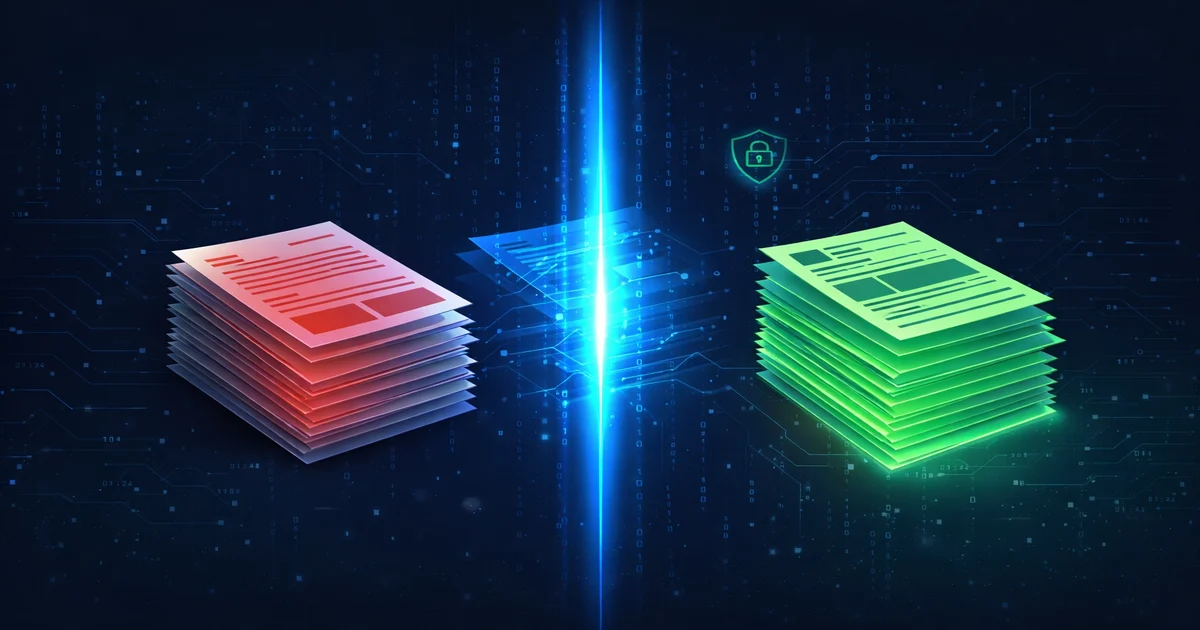
The easiest way to remove blank pages is to use a tool that can inspect the PDF pages, identify pages that appear empty, let you review those detections, and then generate a new PDF containing only the pages you want to keep.
PDFTEQ's Remove Blank Pages tool performs this workflow directly in your browser.
Why Do Blank Pages Appear in PDFs?
Blank pages can appear for many reasons. They are not necessarily mistakes in the original document.
- Double-sided scanning can create empty backsides.
- Scanning software may insert an empty page between document sections.
- Word processors can create an extra page because of page breaks or formatting.
- Exported documents may contain intentionally empty separator pages.
- Combining multiple PDFs can introduce unwanted pages.
- Scanner workflows can produce nearly white pages containing only insignificant noise.
How to Remove Blank Pages from a PDF Online
-
Select your PDF
Open the PDFTEQ Remove Blank Pages tool and select your PDF file. -
Let the browser scan the pages
Each page is rendered locally and checked for predominantly white visual content. -
Review the detected pages
Pages identified as likely blank are marked for removal. You can change their status before export. -
Create the cleaned PDF
The selected pages are copied into a new PDF and downloaded to your device.
How Automatic Blank-Page Detection Works
A PDF page does not have a universal property that says "this page is blank." A page can contain a white background, invisible objects, faint scanner marks, almost-white text, or other elements.
PDFTEQ therefore uses a visual approach.
- pdf.js opens the PDF in the browser.
- Each page is rendered to an HTML Canvas.
- The rendered pixel data is sampled.
- Very light pixels are compared with the total sampled pixels.
- Pages that exceed the configured light-pixel threshold are marked as likely blank.
This is a heuristic visual detector , not an AI model.
What Does "Blank" Mean?
For the current PDFTEQ detector, a page is considered likely blank when approximately 99% of its sampled pixels are very light.
The purpose of this threshold is to identify pages that are visually almost entirely empty while avoiding the much more dangerous approach of deleting pages based only on whether the PDF contains a text object.
Can It Remove Blank Pages from Scanned PDFs?
Yes, it can detect visually empty pages in many scanned PDFs because the detection operates on the rendered appearance of the page rather than requiring a native text layer.
However, scanned documents introduce additional variables:
- paper shadows;
- scanner dust;
- gray paper backgrounds;
- faint ink;
- cropping borders;
- compression artifacts.
These factors can affect whether a page crosses the blank-page threshold.
When Blank-Page Detection Can Make a Mistake
Automatic detection should never be treated as a guarantee of document intent.
| Page type | Possible result | Recommendation |
|---|---|---|
| Completely white page | Likely detected | Usually safe after review |
| Very faint text | May be detected | Review carefully |
| Signature page | Depends on visible ink | Always review |
| Scanner-shadow page | May not be detected | Review preview |
| Separator page | May be detected | Keep if intentional |
Why You Should Review Detected Pages
The most important design decision in a blank-page removal tool is not simply detecting pages. It is giving the user a chance to verify the decision.
PDFTEQ marks pages as likely blank but does not force the user to remove them.
This is especially important for:
- legal documents;
- contracts;
- financial records;
- signed documents;
- medical records;
- archival documents;
- scanned paperwork.
Is It Safe to Remove Blank Pages Online?
Security depends heavily on how the PDF tool processes your document.
Many online PDF services use a server-based architecture where your document is uploaded for processing.
PDFTEQ's Remove Blank Pages tool uses a different model: the PDF is processed in your browser using JavaScript.
The selected PDF is read into the browser and processed locally. The tool does not need to upload the document to PDFTEQ's server.
If your document is highly sensitive, you should still follow your organization's own document-handling policy.
The Technology Behind PDFTEQ's Tool
| Component | Role |
|---|---|
| pdf.js | Opens and renders PDF pages in the browser. |
| HTML Canvas | Provides rendered pixel data for visual analysis. |
| JavaScript | Controls detection, preview, interaction and processing workflow. |
| pdf-lib | Creates the resulting PDF from the pages selected to keep. |
The architecture deliberately keeps the workflow in the browser so the document does not have to be sent to a PDFTEQ processing server.
Does Removing Pages Change the Original PDF?
No. The original file selected from your device is not overwritten.
PDFTEQ creates a separate PDF containing the pages that you selected to keep.
Creating a new PDF should not be assumed to preserve the validity of a digital signature from the original file. If a document is digitally signed, keep the original and validate the resulting file separately.
What About PDF/A Documents?
PDF/A is an archival standard with additional requirements beyond simply opening and copying PDF pages.
Because this tool creates a new PDF, you should not assume that the resulting file automatically remains compliant with every PDF/A requirement.
If archival compliance matters, validate the resulting document with an appropriate PDF/A validation workflow.
Can I Remove Blank PDF Pages on Android or iPhone?
Yes, provided your mobile browser has sufficient memory for the PDF.
The workflow is the same:
- Select the PDF from your device.
- Wait while the browser analyzes the pages.
- Review detected pages.
- Create the cleaned PDF.
Very large PDFs may perform better on a desktop or laptop because browser memory is more limited on many mobile devices.
Troubleshooting Blank-Page Removal
The PDF does not open
Make sure the file is a valid PDF and is not corrupted. Password-protected documents may need to be unlocked first.
A page was incorrectly detected as blank
Review the page preview and change its status to Keep. Automatic detection is intentionally treated as a recommendation.
A blank page was not detected
Scanner shadows, gray backgrounds, borders, and other marks may cause an apparently empty page to contain enough non-white pixels to fall below the detection threshold.
The browser becomes slow
Browser-based PDF processing uses your device's memory and CPU. Large documents or PDFs with many pages can require more resources.
Who Can Benefit from Removing Blank PDF Pages?
Students
Remove empty pages accidentally introduced when scanning assignments, notes or study material.
Businesses
Clean scanned reports, invoices, contracts and internal documents before sharing them.
Legal Workflows
Remove genuinely unwanted empty pages from document bundles while keeping the original file for reference. Always review legal documents carefully before export.
Administration
Clean scanned applications, forms and supporting documentation before archiving or distributing them.
Remove Blank Pages from Your PDF
Detect likely blank pages, review them and create a cleaned PDF directly in your browser.
Remove Blank Pages Free →Related PDF Tools
Frequently Asked Questions
Is it free to remove blank pages from a PDF?
Yes. PDFTEQ provides the Remove Blank Pages tool free to use in the browser.
Does PDFTEQ upload my PDF?
No. The Remove Blank Pages tool processes the PDF locally in your browser and does not require the document to be uploaded to PDFTEQ's server.
How does PDFTEQ detect blank pages?
PDF pages are rendered using pdf.js and sampled at the pixel level. Pages containing a very high proportion of very light pixels are identified as likely blank.
Can automatic detection delete an important page?
The detector can make mistakes with very faint content, scanner artifacts or light backgrounds. The tool therefore lets you review and change detected pages before the final PDF is created.
Can I keep a detected blank page?
Yes. Click the page preview to change its status before creating the cleaned PDF.
Does it work with scanned PDFs?
Yes, visually blank pages in scanned PDFs can be detected because the tool analyzes rendered pixels. Scanner shadows, dust, paper texture and faint marks can affect detection.
Does the tool change my original PDF?
No. The original file is not overwritten. A separate PDF is generated from the pages selected to keep.
Can password-protected PDFs be processed?
Password-protected PDFs may need to be unlocked before they can be processed by the browser PDF engine.
Will digital signatures remain valid?
Do not assume that an original digital signature will remain valid after creating a new PDF. Keep the original signed file and validate the resulting document if signature integrity is important.
What should I do if the cleaned PDF is important?
Always keep the original PDF, review the detected pages before export, and verify important document features after creating the new file.
Final Takeaway
Removing blank pages sounds simple, but a PDF can contain faint content, scanner artifacts and intentionally empty pages that make automatic detection imperfect.
The safest workflow is therefore: detect → review → remove → verify.
PDFTEQ follows this approach by processing the document in the browser, identifying likely blank pages visually, showing the page previews and allowing you to decide which pages remain in the resulting PDF.